Founder Insights · November 3, 2026
ARTËMER: A Little Off-Center, Recognizable Everywhere
A small triangle diamond helped establish ARTËMER’s place in alternative bridal. Co-founder Tanya explains how the brand carried its point of view from Etsy to its own website—and how AI is prompting her to reconsider the words around the work.

ARTËMER’s first bestseller put a small triangle diamond off-center. In Tanya’s recollection, the ring was minimalist, dainty and easy to stack. The surprise was the stone: a cut that usually played a supporting role had become the center of the design.
“It took off quickly and established us as a distinctive bridal brand,” she says.
The ring offers a useful way into ARTËMER’s story. An unexpected composition made something familiar feel different, while leaving it wearable enough to become part of someone’s everyday life. Years later, that balance remains central to how Tanya describes the brand she built with Tomer.
“We don’t design to shock; we design to be different in a way that lasts.”
In an email interview with Found & Form, Tanya traces how that design identity became a business: early attention on Etsy, a website she wishes they had launched sooner, images that traveled on Pinterest, and product language chosen with search in mind. Her account also captures a question now occupying many independent founders: how should a brand describe itself when an AI assistant might be doing some of the reading?
A distinctive ring, and words to describe it
Tanya says ARTËMER wanted a cohesive aesthetic from the beginning. Recognition was intentional, although the boundaries around the work have become less rigid.
“Over the years, though, we’ve loosened up,” she says. “We’ve given ourselves more creative freedom to explore new directions and to be playful.”
When the business launched in 2011, she recalls finding relatively few alternative bridal brands online. The early pieces attracted attention on Etsy because they offered something she felt was missing: jewelry that was distinctive and still easy to wear. The off-center triangle ring became an early expression of that approach.
Her language for the jewelry is precise. Geometric lines. Baguettes in unexpected positions. Stones set away from the center. A composition that asks someone to look again.
That precision extended to the online catalog. Before ARTËMER, Tanya had worked at a small startup, where she learned the basics of SEO. When she began building listings, product pages and collections, she was already considering how a stranger might find them.
She chose phrases she felt described the work accurately and were not yet crowded in search: Art Deco, geometric, baguette, alternative engagement ring.
“I built our SEO around them, stayed consistent and trusted that time was on our side.”
Tanya believes the brand’s early presence helped it develop authority around those descriptions. Some product pages, she says, have remained live for more than a decade, and a few have been kept mainly for their search value. Those are her observations about ARTËMER’s history, rather than a controlled account of what caused its rankings. They do show how deliberately she approached the words surrounding the work.
For her, the product descriptions were part of building the brand from the start.
Etsy’s changing place

Tanya dates ARTËMER’s Etsy opening to 2011 and its independent website to 2015. Etsy was crucial during those first years, she says. As the brand became more recognizable and its social audience grew, the marketplace stopped being its main sales channel.
The shop remains open. Tanya gives several reasons: people can still encounter the brand there, it has a place in the company’s history, and maintaining an official presence helps customers identify the original work when similar imagery or designs circulate.
She describes copying as a continuing frustration and says the platform’s reporting tools offer some recourse. Her experience has also made her more cautious about Etsy’s role for a new business today. The opportunity she remembers from ARTËMER’s early years is not necessarily the opportunity a designer would find now.
Asked what she would do differently if she were starting again, she gives a direct answer.
“I wouldn’t wait four years to launch an independent site.”
The advice comes from someone who credits the marketplace with helping the business begin. Its importance changed as ARTËMER developed an identity and audience of its own.
The image before the product
Pinterest was the unexpected discovery channel. Tanya recalls substantial traffic arriving as images of ARTËMER’s pieces circulated there.
“On Pinterest, the effort isn’t in the platform itself but in creating an image people want to save,” she says. “Online, you sell the image of the product first, not the product itself.”
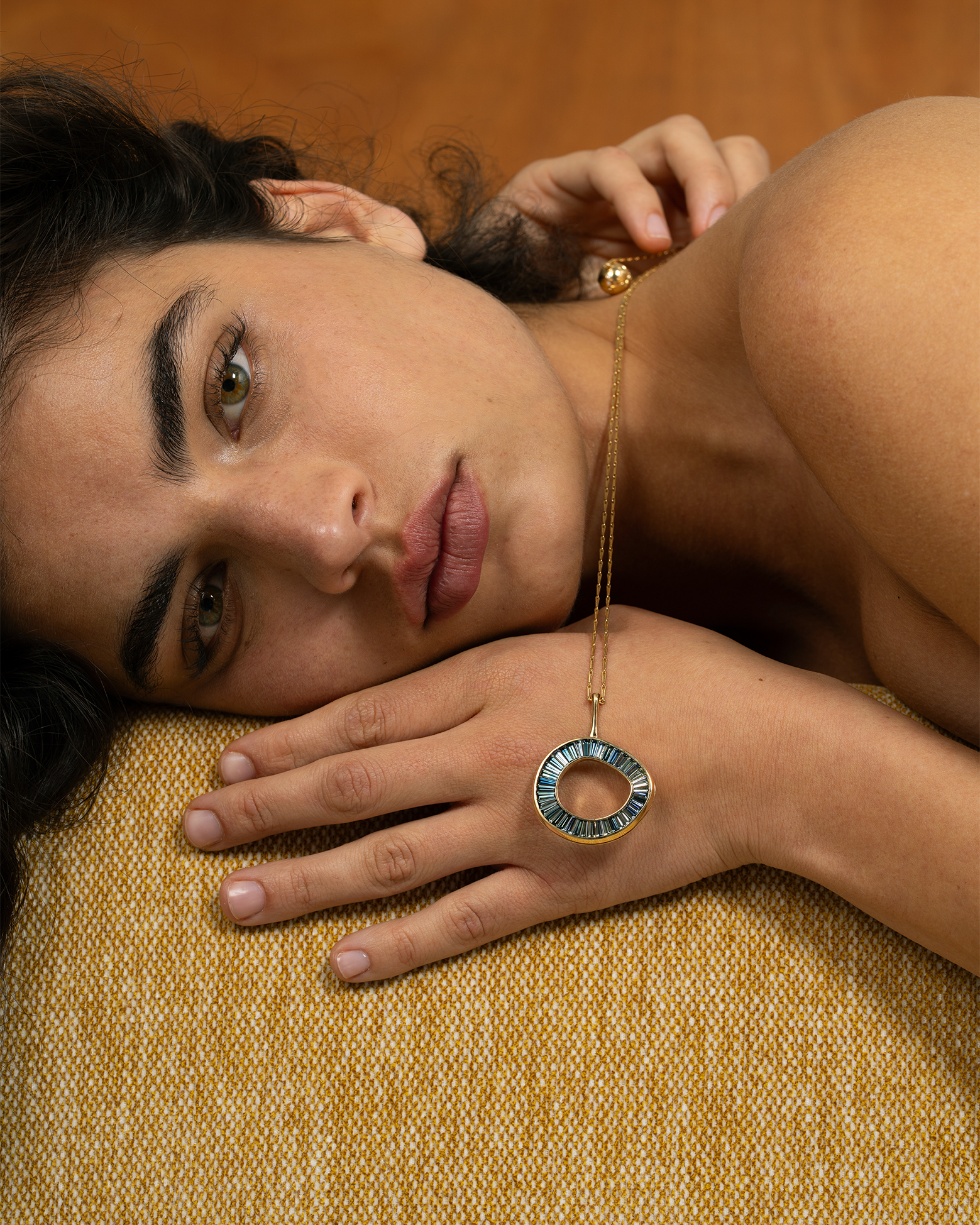
For a brand whose distinctions often lie in proportion and composition, the photograph has a specific job. It has to make the arrangement visible: the unusual placement of a baguette, the shape of a stone, the relationship between one ring and another.
An image can introduce those choices before someone knows the designer’s name or has the vocabulary to describe the piece. Tanya’s account of Pinterest is about that experience of circulation; she did not provide traffic figures or attribution data for this interview.
Instagram, meanwhile, is where she says most of the brand’s effort and hard work goes. She considers it worthwhile for a visual business. Together, her descriptions of the two channels reveal different demands: making imagery people want to save and circulate, and sustaining the work of communicating a brand over time.
A new reader for the product page
Tanya’s current questions about discovery center on AI. Over the past year, she says, she has been considering what assistants might mean for the search work ARTËMER has done for so long.
When writing a listing, she now wonders whether to picture someone typing a search or an AI system reading and interpreting the page.
Her interview does not establish that shoppers have broadly abandoned Google, nor does she supply customer-attribution evidence showing how much business arrives through AI assistants. What it does record is a founder adjusting the questions she asks of her own catalog.
“So now I think in key phrases, even key sentences, not just keywords.”
She wants newer pages and product descriptions to carry a consistent explanation of ARTËMER: what it makes, what distinguishes it, and whom it is for. This is an approach she intends to develop, rather than a tested formula for earning AI recommendations.
It also builds on a habit already visible in her account of the early business. She had selected words that matched the jewelry’s aesthetic. Now she is considering how complete sentences might carry that identity across different pages and readers.
“I genuinely enjoy SEO; it’s like a game,” she says. “You plant seeds today and watch them grow over time. This just feels like planting a different kind of seed.”
What she hopes survives the first glance
Ask Tanya what should make an unfamiliar viewer stop at an ARTËMER piece, and she returns to the jewelry itself.
“I hope it’s the tension between the unexpected and the wearable.”
The first attraction may be a geometric composition or a stone playing an unfamiliar role. With a closer look, she hopes the wearer sees the work of refining proportions, finish and stone selection.
“The design catches your eye, and the craftsmanship is what makes you appreciate it.”
That is the continuity in her account, from a triangle diamond ring gaining attention on Etsy to a founder thinking about how an assistant reads a product page. The platforms and the language around discovery keep changing. The piece still has to give someone a reason to stop, look closer and want to wear it.
Based on Tanya’s written answers to Found & Form, received October 21, 2026. This feature reports the founder’s experience; it does not independently attribute business results to particular channels. Related research: ARTËMER Discovery Study.
Explore ARTËMER and its official Instagram @artemer.