A jewelry designer can spend months perfecting a collection, choose a memorable domain, and build a beautiful storefront—then discover that almost nobody searching for that kind of jewelry encounters it.
The problem isn't necessarily the website. It's the assumption that having a website and being discovered are the same thing.
That distinction is especially important for independent jewelry businesses weighing three different routes: an Etsy shop, a website built with Etsy Pattern, or a separately operated e-commerce site. These options differ in ownership, presentation, operations, and where customers might encounter a product. None automatically guarantees visibility in Google or AI-assisted shopping recommendations.
Three storefronts, three different discovery questions
An Etsy shop is a storefront inside a marketplace. A shopper may find a product through Etsy's internal search, through a specific Etsy listing appearing in Google, or through a link from elsewhere. The seller's shop homepage and individual product listings are not the same search-reporting unit.
An Etsy Pattern website gives a seller a separate site connected to their Etsy business. Etsy's own Pattern documentation ↗ describes a website channel that can use the seller's Etsy inventory; Pattern products do not become more visible in Etsy marketplace search simply because they appear on the separate site. Etsy also documents custom-domain options ↗, so a Pattern website need not visibly use a patternbyetsy.com address.
An independently operated website, such as a Shopify store, gives the brand a distinct domain and merchant-managed storefront. But independence alone does not establish that Google will rank its products, that shoppers will search for them, or that AI assistants will recommend them.
The more useful question is not Which platform has a website? It is: When someone doesn't know the brand's name, can they find its jewelry?
What an initial search review actually showed
The Found & Form research record documents a small set of jewelry properties reviewed using Semrush's US desktop organic-search database on October 9, 2026. Sunflower Jam's figures were independently rechecked against an October 10 Semrush screenshot. The researcher has confirmed the other properties' October 9 figures against the original Semrush exports. Semrush's Organic Rankings documentation ↗ explains its keyword-position reporting; its traffic numbers are modeled estimates, not the businesses' own analytics.
More keywords does not always mean more discovery
Detected ranking keywords · US desktop · October 9, 2026
| Property | Scope reviewed | Semrush ranking keywords | Modeled monthly organic visits |
|---|---|---|---|
| Ellie & Erie | ellienerie.patternbyetsy.com | 0 | 0 |
| Elentari Handverk | elentarihandverk.patternbyetsy.com | 0 | 0 |
| Sunflower Jam ↗ | Independent Shopify root domain | 14 | 4 |
| GS14KJEWELRYSTORE ↗ | Separate custom root domain; exact platform unverified | 52 | 31 |
How to read these estimates. The Sunflower Jam figures were independently rechecked on October 10. The other figures were checked by the researcher against the October 9 Semrush exports. These are not matched businesses, and the reporting scopes are not equivalent to a complete Etsy marketplace presence. Zero in Semrush means zero detected or modeled in this database and scope—not zero Google indexing, visitors, or sales. We have not established whether the two Pattern-subdomain sellers also operate custom domains. The GS14KJEWELRYSTORE domain must not be treated as a confirmed Pattern implementation based only on a “Powered by Etsy” footer.
The numbers are useful for asking better questions, not declaring a winner.
A small keyword footprint can contain meaningful discovery
At the time of the review, Sunflower Jam ↗ had just 14 detected ranking keywords and four modeled monthly organic visits. Those figures sound modest. The October 10, 2026 Semrush US desktop screenshot independently confirms the 14-keyword and four-visit estimates. It also shows zero modeled branded visits and four modeled non-branded visits. These are modeled estimates, not the site's own analytics. Two product-specific rankings tell a more interesting story:
- Its Penny Pendant page ranked No. 4 for “penny pendant,” a query Semrush estimated at 70 US monthly searches.
- Its Sunflower Seed product page ranked No. 7 for “gold sunflower charm,” also estimated at 70 US monthly searches.
These are plausible ways for a shopper unfamiliar with the brand to discover a relevant product. That matters more to a jewelry founder than an undifferentiated keyword total.
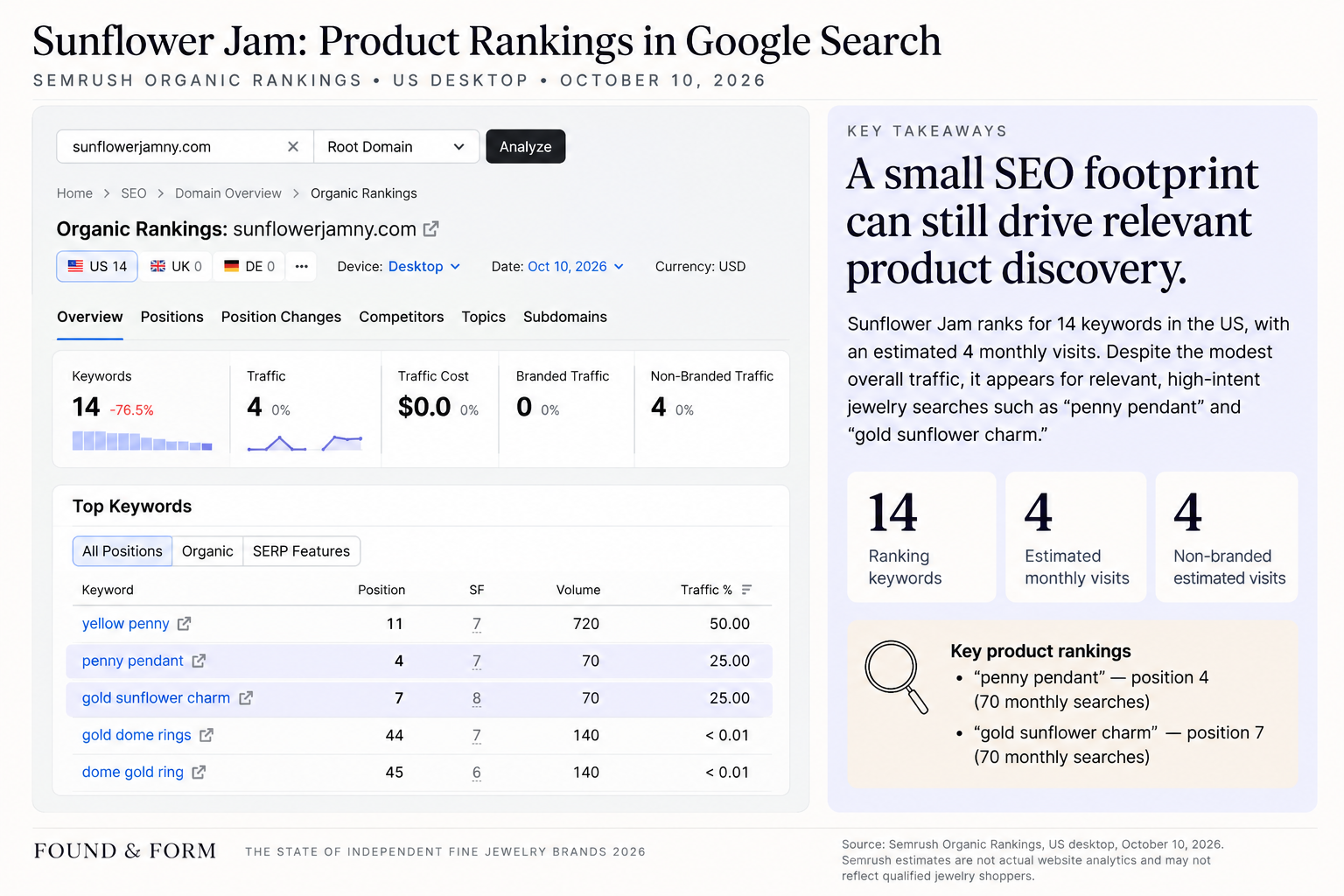
Source: Semrush Organic Rankings, US desktop, October 10, 2026. The accompanying Found & Form graphic is an editorial recreation of the research screenshot, not an original Semrush screenshot. Semrush estimates are not actual website analytics.
There is a caveat even here: “yellow penny,” which appeared at position 11, accounted for a substantial share of the site's modeled traffic despite having ambiguous shopping intent. A query can produce an impression or a ranking without representing a likely jewelry customer. The rest of the keyword set was not fully classified, so we cannot calculate the site's total qualified non-branded visibility.
More keywords can still mean mostly branded demand
The separate domain for GS14KJEWELRYSTORE ↗ had a larger Semrush footprint: 52 detected keywords and 31 modeled monthly visits. Yet approximately 93.5% of its modeled traffic share came from two name-related searches, “gs 14k” and “14k gs.”
That is not a failure. Branded searches are valuable: they may indicate people already know the business. But they answer a different question from whether the site introduces its products to shoppers who have never heard of it.
A larger keyword count does not necessarily mean a stronger presence for searches such as gold charms, gemstone pendants, or handmade diamond jewelry.
Most modeled visits came from name-related searches
GS14KJEWELRYSTORE · two name-related queries accounted for approximately 93.5% of modeled traffic share.
The comparison that would be misleading
One early observation showed the GS14KJEWELRYSTORE Etsy shop homepage ↗ with three detected name-related keywords and zero modeled visits in its shop-URL scope.
It would be tempting to put that number beside the custom domain's 52 keywords and announce that a separate website performs better.
That would be wrong.
Many Etsy product listings have URLs under etsy.com/listing/..., not under etsy.com/shop/SHOPNAME. A shop-homepage report therefore does not measure the Google visibility of all that seller's Etsy listings. It also does not measure discovery inside Etsy, where marketplace search and customer behavior follow a different path.
Comparing a full independent domain with an Etsy shop URL is not an apples-to-apples SEO test. For Etsy-only sellers, listing-level Google visibility and marketplace discovery must be assessed separately.
What jewelry founders should measure instead
For a small brand deciding whether to invest in a separate website, four questions are more practical than asking which platform “wins”:
- Are unfamiliar customers finding products? Separate brand-name searches from non-branded searches that describe a material, motif, style, or product type.
- Which exact pages rank? A product page ranking for a relevant query can be more actionable than a larger domain-level keyword total dominated by navigational searches.
- Can search engines understand the catalog? Review descriptive product titles, clear category navigation, indexable pages, canonical URLs, and appropriate product information. A custom domain is not a substitute for this work.
- Where does the customer actually arrive? An Etsy listing, a Pattern product page, and an independent checkout are different experiences. Track them separately before comparing outcomes.
A brand can keep its niche and still make it understandable to people who don't know its vocabulary yet. The goal isn't to become more generic; it's to describe the distinctive jewelry in ways a potential customer might genuinely search.
What this research cannot tell us—yet
This is an exploratory observation of four web properties, not a controlled study of platform effectiveness. The sellers differ in products, business age, reputation, catalog size, and likely marketing activity. Two Pattern subdomains had no Semrush-detected keywords in the selected database, but we cannot infer that their owners receive no organic traffic or that Pattern caused that outcome.
We also have not completed matched Etsy-only versus Pattern versus independent-store cohorts, equivalent Etsy listing-level checks, technical audits, or frozen AI-discovery prompt testing. We therefore cannot responsibly conclude that Shopify beats Pattern, that Pattern harms SEO, or that a custom domain increases AI recommendations.
Those are questions for the next stage of Found & Form's independent jewelry discovery research ↗, not conclusions hidden inside a small pilot.
The real decision isn't Etsy versus your own website
A marketplace can help a brand reach people who are already shopping there. A separate website can give a brand a dedicated place to explain its work and develop its own search presence. The value of either depends on how customers discover the jewelry and what happens after they arrive.
The early evidence points to one durable distinction: a storefront is infrastructure; discoverability is an outcome.
For independent jewelry brands, the next useful investment may not be another platform migration. It may be learning which products already attract relevant searches, which pages answer those searches clearly, and which parts of the collection remain invisible to shoppers who would genuinely love them.
Research note and sources
Method: Manual review of Semrush US desktop Organic Research observations collected October 9, 2026. Keywords and modeled visits are third-party estimates, not verified traffic or sales. Brand-level observations are descriptive and non-causal. No matched-cohort or AI visibility conclusion is presented.
Source verification (October 11, 2026): The official Etsy Pattern and domain help pages were opened and checked; the Semrush methodology page was opened and checked. Ellie & Erie and Elentari Handverk resolve at their stated Pattern subdomains; Sunflower Jam's live site displays a Shopify footer and both named products; GS14KJEWELRYSTORE's custom domain and Etsy shop resolve and show the same shop identity, but a footer alone does not conclusively establish its platform implementation. The Sunflower Jam keyword count, modeled visits, and two product rankings were rechecked against the October 10 screenshot. The researcher confirmed the October 9 Semrush keyword counts and modeled traffic estimates for Ellie & Erie, Elentari Handverk, and GS14KJEWELRYSTORE, including the 93.5% branded-traffic calculation, against the original exports.
Platform documentation: Etsy: Getting Started With Pattern ↗; Etsy: Pattern domain options ↗. Metric methodology: Semrush: Organic Rankings ↗. Observed properties: Sunflower Jam ↗; GS14KJEWELRYSTORE ↗; GS14KJEWELRYSTORE Etsy shop ↗.