In a matter of days, one familiar piece of Google Search nearly vanished across much of Europe.
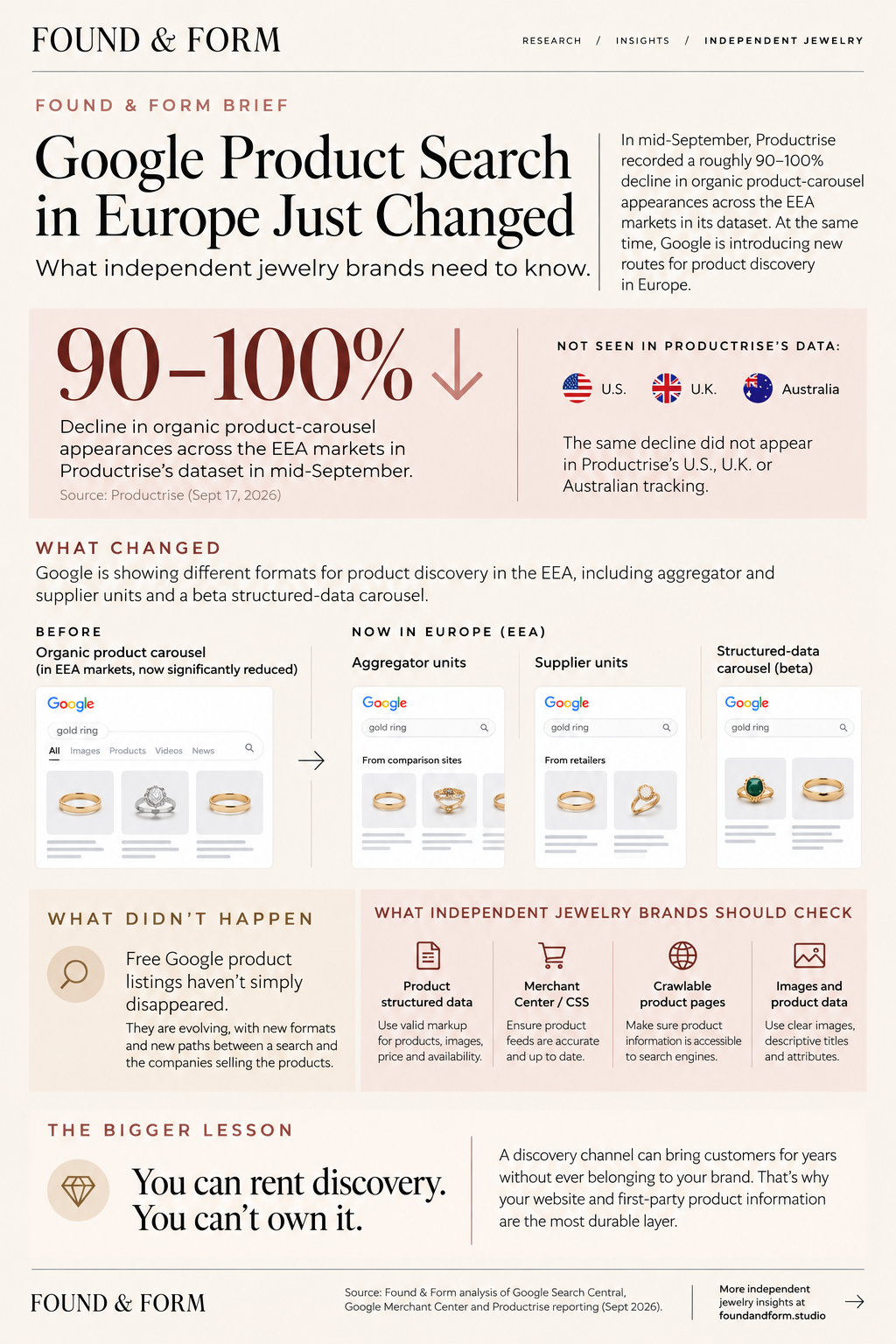
Productrise, which tracks ecommerce visibility in Google, recorded declines of roughly 90 to 100 percent in organic product-carousel appearances across the European Economic Area markets in its dataset in mid-September. The same collapse did not appear in its U.S., U.K. or Australian tracking.
For an independent jewelry designer, a product carousel could do something particularly valuable: put a ring, necklace or pair of earrings in front of a shopper who had never heard of the brand that made it.
Then the search results changed.
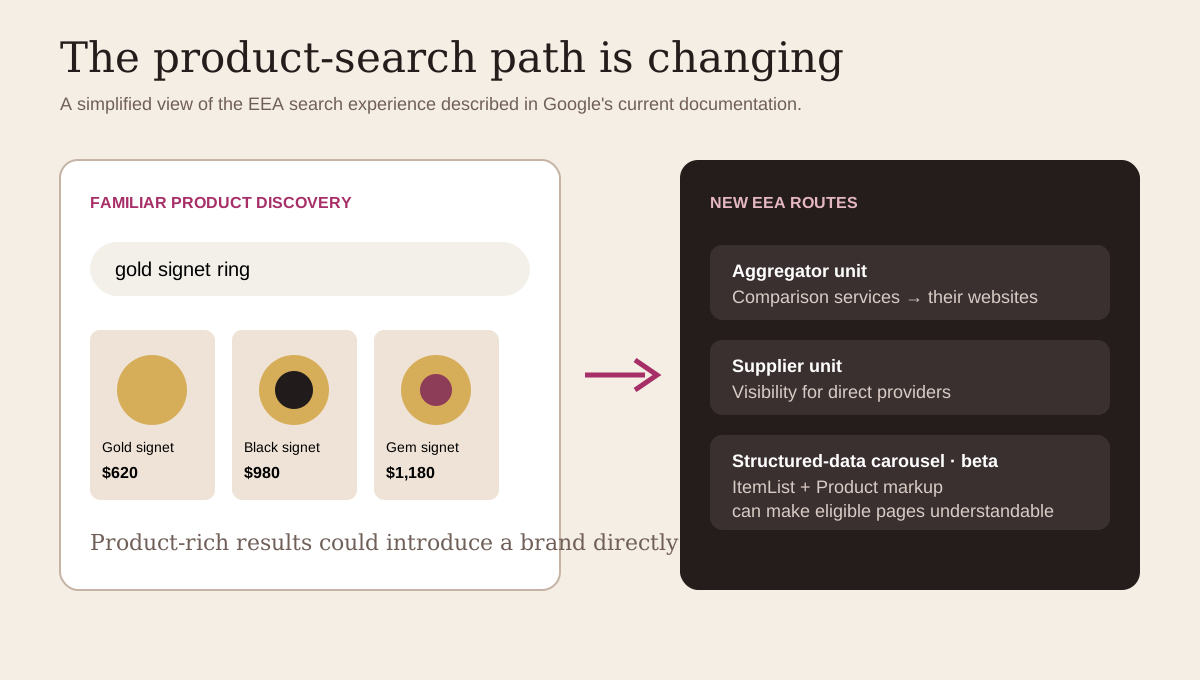
Google's current Search Central documentation describes a restructured product-search experience in the EEA, including new routes for Comparison Shopping Services and direct suppliers. The familiar product carousels documented by independent trackers have sharply receded, while Google documents aggregator units, supplier units and a beta structured-data carousel for eligible product searches.
Free product listings have not simply disappeared from Google in Europe. Google's Merchant Center documentation still describes cost-free product listings. What has changed is more consequential than that headline suggests: the path between a shopper's search and the company selling the product is being redesigned.
For small jewelry brands, the episode illustrates a larger vulnerability. A discovery channel can deliver customers for years without ever belonging to the brand using it.
The change at a glance
What actually changed
Google says it is evolving the search results page for certain query types in the EEA to create new opportunities for Vertical Search Services, Comparison Shopping Services, direct suppliers and content providers. For product searches, its documentation lists an aggregator unit and a supplier unit.
In the aggregator unit, eligible comparison services can populate a search feature with results relevant to the query, and a click within that unit leads to the aggregator's website. Google's documentation describes the supplier unit as a way to provide visibility to direct providers.
Google has also documented a beta structured-data carousel for eligible product queries in the EEA. Sites can become eligible by using ItemList structured data together with Product markup on an appropriate page. Google cautions that correct markup makes a page eligible for the feature but does not guarantee that it will appear.
Independent monitoring provides the other half of the picture. Productrise reported that the older organic product-carousel presence dropped dramatically across the EEA in mid-September and later documented a newer Comparison Shopping Service carousel appearing for many of its tracked queries. Those measurements come from Productrise's query set, not Google, and should be treated as an early view of the change rather than a complete measure of European search.
Why this matters for independent jewelry brands
Fine jewelry is unusually dependent on visual discovery. A shopper may not begin with a designer's name. She may search for a black diamond signet ring, an unusual gold wedding band, a sapphire pendant or a handmade engagement ring.
For an independent designer, appearing visually during that search can introduce the brand before the shopper knows it exists. That makes product-rich search results valuable, and smaller brands have less margin for losing a discovery surface.
A large retailer can spread customer acquisition across paid search, affiliates, email, stores, social media, marketplaces, PR and other channels. An independent designer may rely much more heavily on a handful of discovery sources.
Being present on Google and controlling how customers discover you are not the same thing.
There is another route appearing
The newer structured-data carousel is notable because it puts more emphasis on something brands actually control: the structure and clarity of their own websites.
Google says each tile in the beta carousel may contain information from the site about price, ratings and images. For product queries in the EEA, the feature uses ItemList markup alongside Product structured data.
For a small jewelry brand, seemingly mundane website details become consequential. Can a machine clearly identify which pages contain products? Are product names descriptive? Are materials and prices explicit? Are images crawlable? Does the site make the relationship between a collection and its products understandable?
Those questions increasingly sit at the intersection of SEO, shopping feeds and AI discovery.
This is bigger than Google
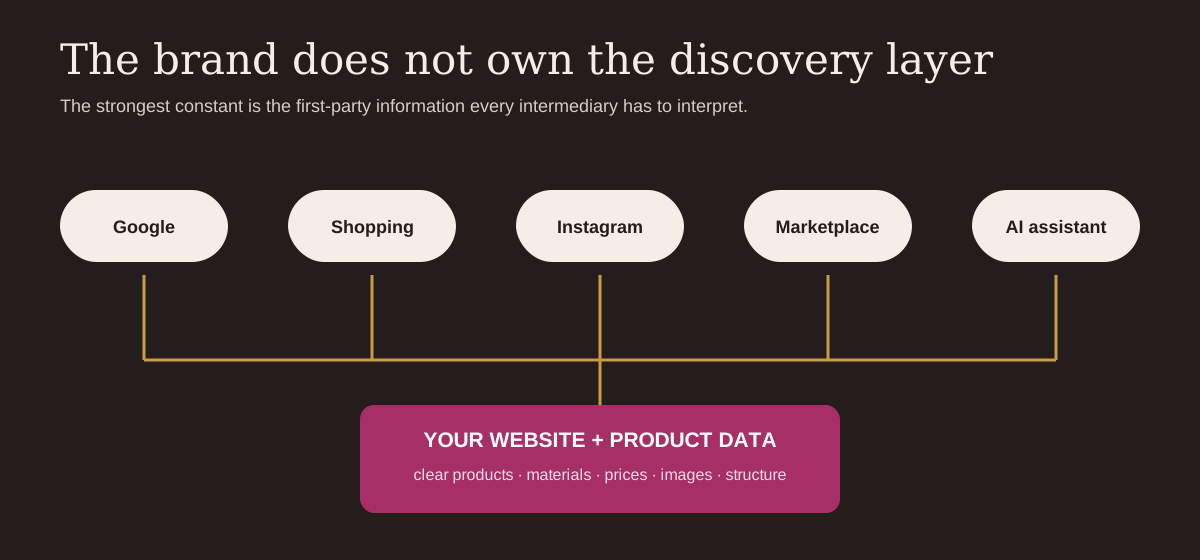
A jewelry designer may now be discovered through Google Search, Google Shopping, Instagram, Etsy, a retailer, an editorial article, ChatGPT or another AI shopping experience.
Each can be valuable. None belongs to the brand.
Marketplaces can change algorithms. Social platforms can change reach. Search engines can redesign results. AI systems can change which sources they use when generating recommendations. The common denominator is the brand's own digital presence.
What jewelry brands should check now
For brands that sell to European customers, the first step is not to panic or immediately spend more on advertising. It is to understand what changed for your own site.
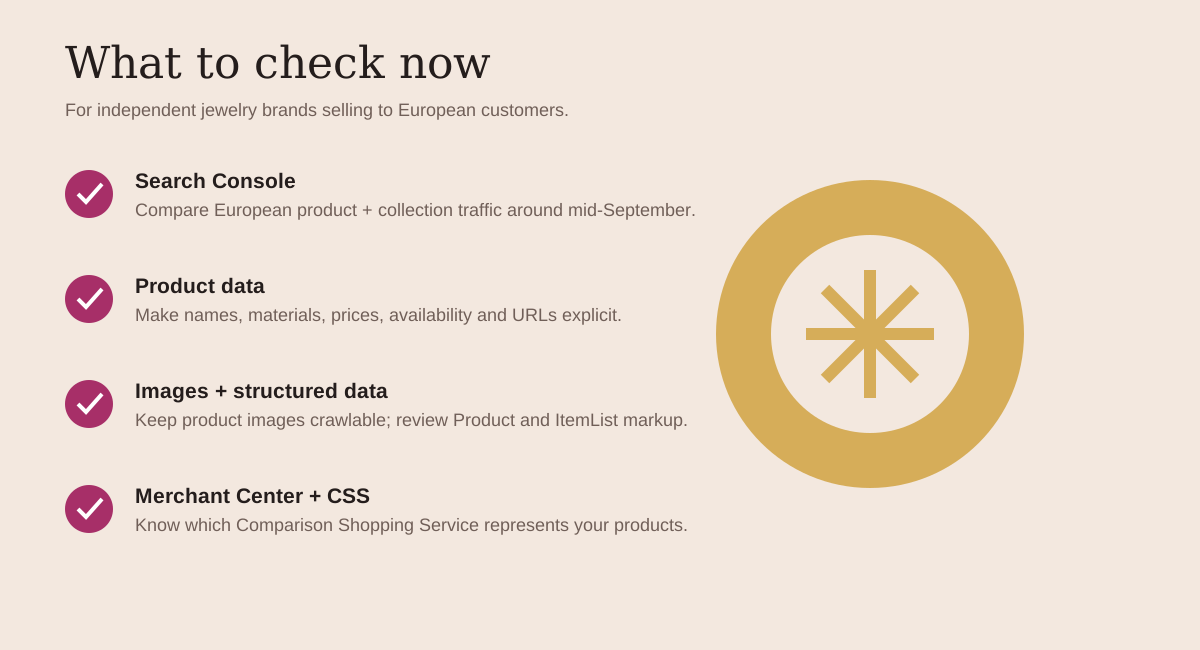
Check Search Console rather than assuming an industry-wide change affected you in exactly the same way. Compare European search traffic before and after mid-September, particularly traffic reaching product and collection pages.
Then examine the underlying product information. Google's free-listings documentation and its structured-data carousel guidance emphasize explicit product information, including images, URLs and prices. Brands using Merchant Center should also understand the Comparison Shopping Service relationship through which products can participate in European shopping experiences.
A clearly structured first-party website gives search engines, shopping systems, journalists, customers and increasingly AI systems a reliable source for understanding what a brand makes and sells.
The larger warning
There is a tendency in ecommerce to think about discovery channels individually. Google is SEO. Instagram is social. Etsy is a marketplace. AI recommendations are something new.
From the perspective of an independent brand, however, they share one important characteristic: they are intermediaries.
A brand can follow the rules, provide its product data and earn visibility, and still wake up to a fundamentally different search results page.
The opportunity is not to predict which platform will change next. It is to build a brand that remains understandable and discoverable when it does.
Reporting note: Found & Form reviewed Google's current Search Central and Merchant Center documentation alongside third-party search tracking. Third-party measurements describe the queries those providers monitored and should not be read as Google's own measurement of all EEA searches.
← All Insights