The short answer: jewelry SEO is the work of making your pieces show up when someone searches for them, on Google, in Google Shopping and increasingly in AI shopping answers. For an independent brand it comes down to five things: the right words, readable product pages, collection pages worth ranking, other sites that mention you, and a site that loads fast on a phone.
Google is still where most shopping starts. In a May 2026 survey of 1,295 US consumers by Smarty Marketing, 56.7% said they begin a product search on Google, 29.0% on Amazon and 7.3% on ChatGPT. Smarty Marketing is an SEO agency, so it has an interest in that answer.
So far, building organic Google visibility remains the highest priority.
This guide walks through each part, with the keyword data and Google’s own documentation behind it.
What do jewelry shoppers actually search for?
Shoppers search for a specific piece, not for “jewelry.” They type a material, a stone, a style or a reason to buy. For a small brand, those specific phrases are where rankings are winnable. “Engagement rings” gets 368,000 US searches a month but has a difficulty score of 61 out of 100. “Garnet ring” gets 8,100, with a score of 19.
How shoppers search for jewelry
Monthly US searches and Semrush keyword difficulty (0–100).
| Search type | Example | Searches/mo | Difficulty |
|---|---|---|---|
| Piece + style | signet ring | 33,100 | 28 |
| Piece + material | 14k gold necklace | 14,800 | 29 |
| Piece + stone | garnet ring | 8,100 | 19 |
| Style word | dainty gold necklace | 3,600 | 16 |
| Feature | tarnish free jewelry | 2,900 | 22 |
| Values | recycled gold jewelry | 590 | 15 |
| Occasion | push present | 12,100 | 22 |
| Broad head term | engagement rings | 368,000 | 61 |
Two patterns stand out. First, one precise word shrinks the competition fast: “handmade jewelry” has 12,100 searches, but “handmade gold jewelry” has 260. Second, how shoppers describe a piece often differs from how its maker does. Nobody searches for “the Aurora ring”; they search for “gold huggie earrings” (6,600 a month, difficulty 17).
The fix is to give each important page one main phrase. The product page gets the specific phrase; the collection page gets the broader one. Our Jewelry Keywords guide lists more of these by category.
How should a jewelry product page be built for search?
A product page ranks when it says, in plain words, exactly what the piece is. Google can’t see that a ring is 14k gold or that the stone is a garnet unless the page tells it. Many jewelry pages lean on a poetic name and a mood line, and the facts shoppers search for go missing.
Title. Lead with what it is, then the name. “Garnet Signet Ring in 14k Gold | The Aurora” tells Google and shoppers far more than “Aurora.”
Description. Put the searchable facts in text, not only in a photo: metal and karat, stone and size, dimensions, chain length, closure, whether it’s handmade, and care. Then tell the story.
Images. Google’s image SEO guidance recommends filenames that are “short, but descriptive” and warns against keyword stuffing in alt text. So garnet-signet-ring-14k-gold.webp, with alt text describing the ring as it’s worn, beats IMG_4471.jpg.
The most important attribute when it comes to providing more metadata for an image is the alt text.
Structured data. Product markup tells Google the price, availability, shipping and return policy in a form it can read directly. Google’s product structured data documentation describes merchant listing markup as being “for pages where customers can purchase products from you.” It adds that “providing both structured data on web pages and a Merchant Center feed maximizes your eligibility.” Shopify themes usually include basic product markup; check that shipping and returns are in it too.
Do collection pages matter for jewelry SEO?
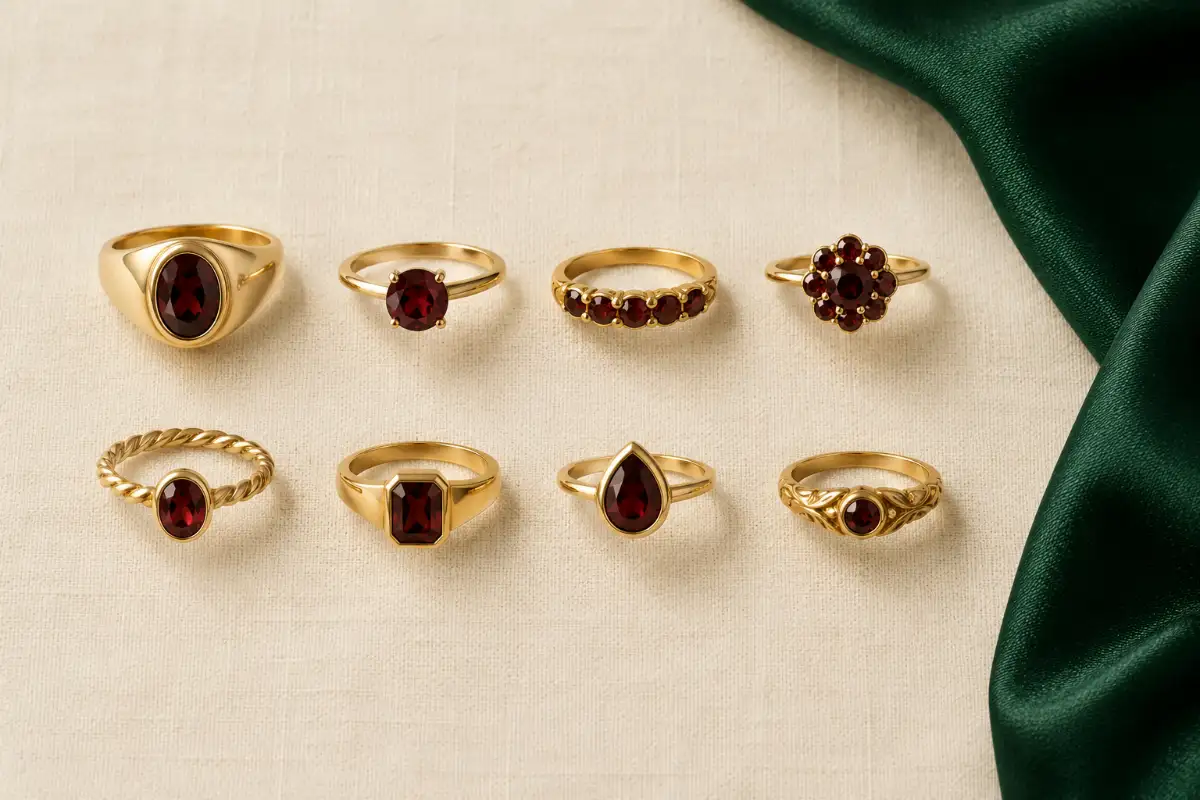
Yes, and often more than product pages. For many jewelry searches, Google ranks collection pages, not individual products. In Semrush’s September 2026 snapshot of US results, all 10 top results for “garnet ring” were collection or category pages. For “gold huggie earrings,” 9 of the top 10 were, with a Pinterest page as the tenth.
Those results weren’t only big retailers. Independent brands held spots next to Jared and Macy’s: Will Work Jewelry ranked third for “garnet ring,” and Musemond and Catbird ranked third and fifth for “gold huggie earrings.”
What that means for your site:
- Name collections the way shoppers search. “Garnet Rings” or “Huggie Earrings,” not “The Ember Edit.” A seasonal name can live in the intro text.
- Give each collection a short intro. Two or three sentences on what’s in it, the metals and stones, and who it’s for. A grid of photos alone gives Google very little to read.
- Link your best sellers from the homepage. Google says that the more internal links point to a page, the more important it looks relative to your other pages.
- Don’t leave empty collections live. Google recommends a noindex tag on a category with no items.
Collections also help Google find your products. Google’s ecommerce site-structure guidance puts it plainly: “If category pages don’t include direct links to all products in a category, Googlebot might not find all of your products by crawling alone.”
How do jewelry brands earn links and mentions?
For jewelry, the links that count come from editors: market roundups, gift guides, wedding features and trade press. Google says it “uses links as a signal when determining the relevancy of pages,” in its link best practices. What matters most is who links to you, not how many sites do.
Two of our Discovery Studies show the difference. Both brands have hundreds of linking sites; the weight of those links is far apart.
Two link profiles
| Brand | Linking sites | Authority Score | Where the links come from |
|---|---|---|---|
| Zoë Chicco | 1,123 | 34 | Vogue, Harper’s Bazaar, Who What Wear (54 links), The Zoe Report (71), Forbes (14), The Knot |
| Nana Bijou | 462 | 9 | Etsy, Pinterest, an awards listing, directories and site-lookup tools |
Zoë Chicco’s link profile was built over years of editorial coverage, not an SEO campaign. Nana Bijou’s count isn’t small, but little of it is fashion editorial or gift-guide coverage.
It isn’t how many sites link to you. It’s who they are.
Ways independent brands tend to earn these links:
- Gift-guide season. Editors build holiday guides months ahead. Have clean product shots, prices and a press contact ready.
- Stockists. Every shop that carries you can link to your site, not only list your name.
- Local and trade press. City magazines, maker features and jewelry trade outlets are easier to reach than national titles.
- Your own research or story. A studio visit or a piece of data gives a writer a reason to link that a product alone doesn’t.
When you link between your own pages, Google asks for anchor text that is “descriptive, reasonably concise, and relevant.” “Shop garnet rings” tells it more than “click here.”
Does jewelry SEO help with AI shopping answers?
Mostly, yes. The same clear product facts that help Google also feed AI shopping tools. OpenAI’s help page on shopping in ChatGPT says it considers “structured metadata from first-party and third-party providers (e.g., price, product description).”
Merchants are ranked based on factors like availability, price, quality, and whether they are the maker or primary seller.
That last point matters for independent jewelers. If you make the piece, your own site is the source ChatGPT is looking for, as long as it can read it.
- Plain facts in text. Metal, karat, stone, size and price, written out on the page and in your markup.
- A clean product feed. Shopify and Google Merchant Center feeds reach both Google Shopping and AI tools.
- Mentions elsewhere. Editorial coverage tells both Google and AI models that your brand is real and worth recommending.
We cover the AI side in more depth in How to Get Your Jewelry Brand Recommended by ChatGPT and When AI Shopping Recommendations Get the Details Wrong.
What technical basics trip up jewelry sites?
Most jewelry sites don’t need deep technical work. They need four things checked, and the biggest is photo weight.
Your phone site is the one that counts. “Google uses the mobile version of a site’s content, crawled with the smartphone agent, for indexing and ranking,” according to its mobile-first indexing guide. If a detail is on desktop but hidden on mobile, Google may not count it.
Heavy photos slow everything down. Jewelry sites live on large, detailed images. Google’s Core Web Vitals guidance asks for the main content to load “within the first 2.5 seconds.” Serve WebP or AVIF, size images to the screen, and keep hero videos short.
Google’s speed targets
| Core Web Vital | What it measures | “Good” target |
|---|---|---|
| Largest Contentful Paint | How fast the main image or text appears | 2.5 seconds or less |
| Interaction to Next Paint | How fast the page reacts to a tap | Under 200 milliseconds |
| Cumulative Layout Shift | How much the page jumps while loading | Under 0.1 |
Variants shouldn’t compete with each other. A ring in three metals can create three near-identical pages. Google’s ecommerce URL guidance says to “include the canonical product URL on all variant pages.” Shopify does this by default; custom builds often don’t.
Marketplace habits don’t carry over. Etsy rewards long, keyword-stacked titles. On your own site, those titles are hard for shoppers to read, and your product page has room to say the same things in the description. Our Nana Bijou study found Etsy-style product names on the brand’s own site, a common pattern for sellers who started on the marketplace.
A jewelry SEO checklist
Check these on your own site
| Area | Check |
|---|---|
| Keywords | Each key page has one main search phrase, matched to how shoppers describe the piece |
| Product titles | What it is first (piece, stone, metal), then the name |
| Product descriptions | Metal, karat, stone, size, length, closure and care written out in text |
| Images | Descriptive filenames and alt text; WebP or AVIF; sized for phones |
| Structured data | Product markup with price, availability, shipping and returns; Merchant Center feed live |
| Collections | Named the way shoppers search, with a 2–3 sentence intro and links to every product |
| Internal links | Best sellers linked from the homepage; descriptive anchor text |
| Links and press | Gift-guide pitches, stockist links, local and trade press |
| Technical | Main content loads in 2.5 seconds on mobile; variants point to one canonical URL; empty collections noindexed |
Jewelry SEO isn’t one trick. It’s a site that describes your pieces the way shoppers search for them, and a brand that other people write about.
FAQ
What is jewelry SEO?
Jewelry SEO is making your product and collection pages show up when shoppers search for pieces like yours on Google, Google Shopping and AI shopping tools. It covers keywords, product pages, collections, links and site speed.
How long does SEO take for a jewelry website?
Changes to titles, descriptions and collections can be picked up as soon as Google recrawls the page. Rankings usually build over months, and links from editors take longest to earn.
Should I optimize product pages or collection pages first?
Start with collections. For searches like “garnet ring” and “gold huggie earrings,” nearly every top result on Google is a collection page, according to Semrush data from September 2026.
Does selling on Etsy help my own website’s SEO?
Not directly. Reviews and rankings earned on Etsy stay on Etsy. A link from your Etsy shop to your site helps a little, but your site needs its own content and links.
Does SEO help my brand show up in ChatGPT?
It helps. OpenAI says ChatGPT shopping uses structured product data such as price and description, and ranks merchants partly on whether they are the maker. Clear product pages serve both.