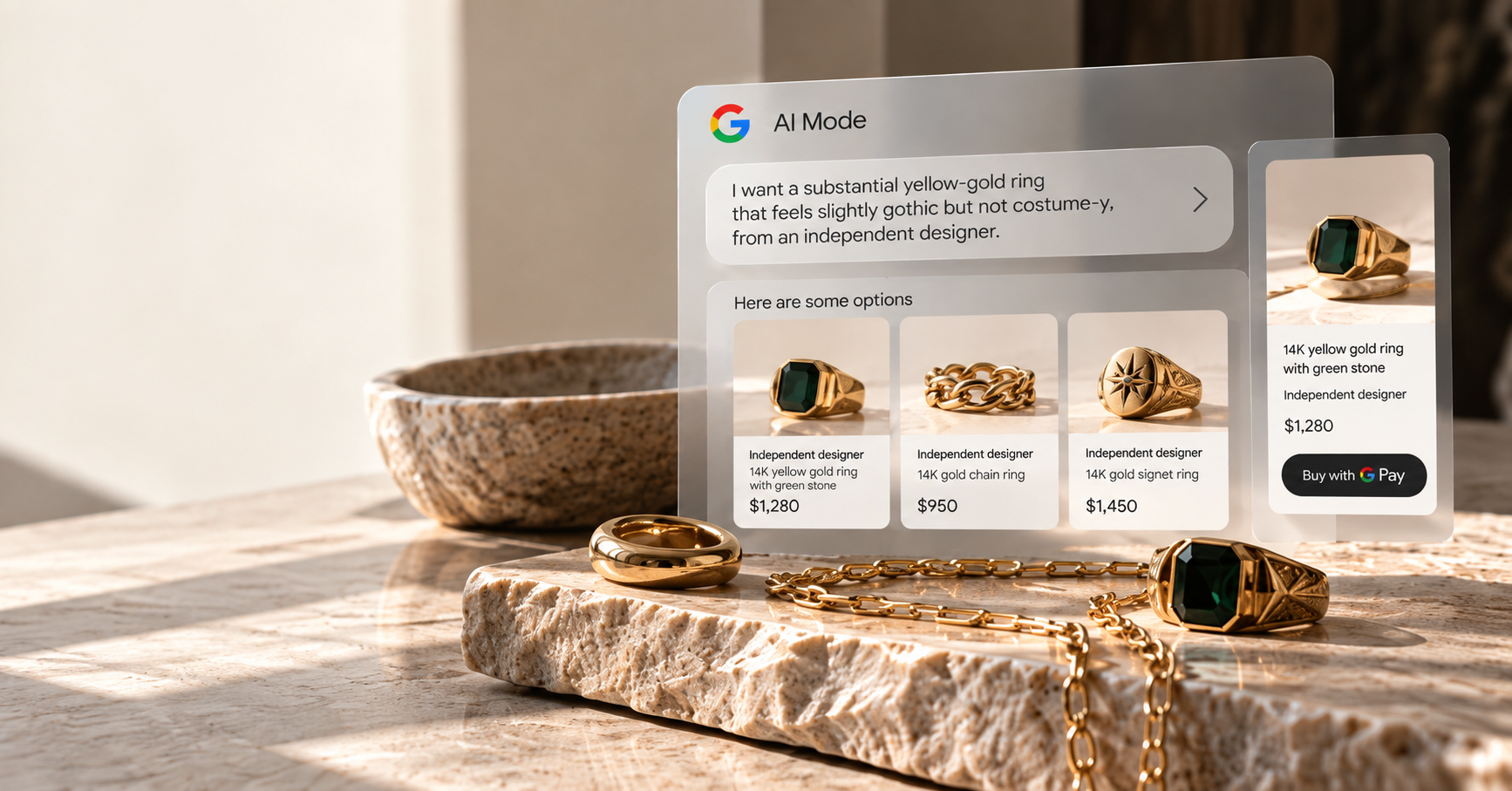
For years, the architecture of Google shopping discovery was familiar: search, click, website. That sequence is beginning to come apart.
Google is building purchasing directly into its AI shopping experiences. Its Search Help documentation describes eligible U.S. shoppers buying participating merchants' products from AI Mode with Google Pay. The merchant remains the seller of record and handles the order, but more of discovery, evaluation and transaction can happen before the shopper follows the traditional ecommerce path.
That distinction matters for independent jewelry brands because the website has historically done much more than process a transaction. It explains the designer, establishes craftsmanship, shows a collection together and gives an unfamiliar object meaning.
The shopping journey is collapsing
Traditional product search
Search
Website
Product
Checkout
AI-mediated shopping
Conversation
AI recommendation
Product comparison
Purchase
The website is still important. It is no longer guaranteed to be the first place a shopper evaluates the product.
From search result to shopping agent
Google's Universal Commerce Protocol documentation describes an open standard intended to let AI agents and merchant systems communicate across commerce experiences. Google positions that infrastructure across the shopping journey, including discovery and checkout.
This is not simply another checkout button. A shopper can increasingly ask an AI system what to buy, compare the products it presents and move toward a transaction without first browsing a brand's collection page or navigation in the way ecommerce teams have traditionally designed.
The product can increasingly have to make its case before the website gets the opportunity to.
AI visibility is becoming merchant infrastructure
Google is also giving merchants more ways to understand how products appear in AI shopping experiences. Its Merchant Center documentation increasingly treats AI discovery as part of the commerce surface rather than a separate experimental channel.
The direction is consequential even before every feature reaches every merchant. Search visibility traditionally asked whether a page ranked. Conversational shopping asks a different question: whether a system understands that a particular product or brand belongs in the answer.
This is especially interesting for jewelry
Jewelry is not a simple product category for a recommendation system to understand. A shopper might once have typed gold ring. She can now describe something closer to what she actually means: I want a substantial yellow-gold ring that feels slightly gothic but not costume-y, with an unusual colored stone, from an independent designer.
The second request contains material, scale, aesthetic, mood, product type and brand preference. An AI system can connect a product with that request only if it has enough information to understand the product in the first place.
What a recommendation system needs to understand
A jewelry product is more than its product type.
Material
14K yellow gold
Product
Talisman pendant
Aesthetic
Gothic · Victorian
Motif
Mourning jewelry
Construction
Hand-carved
Stone
Explicit gemstone
Scale
Dimensions · weight
Price
Current price
Illustrative product attributes, not a Google-required field list. The point is specificity: clear first-party information gives search and recommendation systems more context for matching products to conversational requests.
The product page has a new audience
Historically, product copy had several obvious jobs. It had to persuade a shopper, reduce uncertainty and help a search engine understand the page. There is now another audience: systems attempting to decide whether the product answers a shopper's request.
The difference between 14K gold necklace and 14K yellow gold hand-carved talisman pendant inspired by Victorian mourning jewelry is not merely editorial. The second description provides material, product type, construction, motif, historical reference and aesthetic. Those details create associations, and associations are increasingly what conversational shopping depends on.
What happens to the brand website?
If Google can help someone discover a product, compare it and eventually buy it without requiring the traditional ecommerce journey, what happens to the brand's website?
For a large retailer, losing a product-page visit may be an acceptable trade for a completed transaction. For an independent jewelry designer, the calculation can be different. The website is often where the object acquires meaning. It explains why one gold pendant costs $300 and another costs $3,000.
Google's documented checkout model preserves the merchant relationship in important ways. Participating retailers remain responsible for the transaction and fulfillment. But discovery can increasingly happen somewhere else.
That makes brand identity upstream of the click more important, not less.
Discovery is moving before the website
The old discovery question was: Can someone find my website?
The emerging question is: Can a system understand when my brand is a good answer?
Those are not the same problem. A brand might rank well for its own name while remaining almost invisible when a shopper describes exactly the kind of jewelry it makes. Conversely, a smaller designer with unusually clear product language, strong third-party references and distinctive category associations may be understandable to an AI system without enormous search authority.
That distinction is already visible across Found & Form's Discovery Studies: brand recognition, search visibility and AI association do not always move together.
The next jewelry storefront may not look like a storefront
For jewelry brands, the immediate lesson is not “optimize for AI.” It is more fundamental: make the brand understandable. Make products specific. Describe what makes them different. Maintain accurate, detailed first-party product information. Pay attention to the categories and ideas with which the brand is becoming associated — or failing to become associated.
Because the next customer may never begin by searching for the brand's name.
She may simply describe the piece she wants. Increasingly, an AI system will decide which brands belong in the answer.